
Smart Glasses & Hands-Free Guided Operations
Supporting Safer, More Consistent Work at the Point of Job Execution.
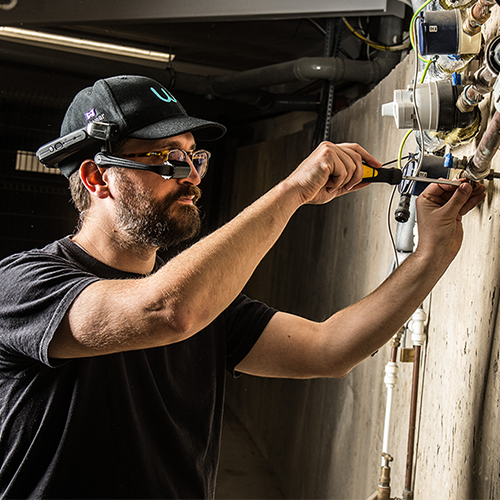
There are many environments where stopping work to use a handheld device isn’t practical or safe.
Service engineers working at height.
Field technicians handling live equipment.
Inspectors wearing protective gloves.
Maintenance teams operating in confined or hazardous spaces.
In these conditions, both hands and full attention are essential.
Hands-free guided operations allow work to continue safely, without forcing people to choose between following the process or staying focused on the task.
Why Hands-Free Working Matters
Frontline work often happens in conditions that don’t suit paperwork, tablets or phones.
Switching between tools and devices introduces issues. Steps can be missed. Evidence is forgotten. Safety is compromised.
Hands-free working removes these problems.
By providing guidance and capturing information without interrupting the task, you support people to complete work accurately while keeping their focus where it belongs.
Smart Glasses as an Enabler, Not the Goal
Smart glasses are sometimes introduced as a niche technology, limited to remote expert support. While that is an importance feature, it only addresses a small part of the operational challenge.
Used well, smart glasses support everyday work.
They allow frontline teams — including inspectors, maintenance engineers and field technicians — to follow clear operating procedures, confirm steps and capture evidence as work is carried out.
The benefit doesn’t come from the hardware alone.
It comes from how hands-free access supports consistent job execution.
Improving Safety Without Slowing Teams Down
In safety-critical environments, accuracy and efficiency must coexist.
Hands-free operations allow inspections and checks to be completed without stopping to record notes or remove protective equipment. Photos, confirmations and readings can be captured as part of the task itself.
This reduces risk while maintaining productivity, and helps ensure that safety and compliance steps are followed even in hazardous conditions.
Supporting Field-Based and Mobile Teams
For service engineers and field technicians, work rarely happens in one place.
Teams move between sites, assets and locations, often working independently. Ensuring consistency across these environments is difficult when guidance relies on memory or regional interpretation.
Hands-free guidance provides a shared reference point for connected frontline working.
Wherever work is carried out, people have access to the same standards, checks and expectations. Without needing to stop, search or improvise.
Training That Happens During the Task
One of the most effective uses of hands-free technology is training.
Instead of separating learning from work, guidance is delivered as tasks are completed. New starters gain confidence faster. Experienced engineers reinforce best practice. Knowledge is shared without formal classroom sessions.
This approach is particularly valuable in environments where mistakes carry real consequences. People can learn safely, in context, without putting assets, safety or compliance at risk.
Free Download:
Tomorrow’s Team eBook
A practicat guide on how digital training and upskilling helps to future-proof operations.
Capturing Accurate Execution Data
Hands-free operations don’t just improve how work is done. They improve what you learn from it.
When digital procedures are followed and evidence is captured in real time, you gain a clear view of how tasks are performed in practice. This supports audits, investigations and continuous improvement, while reducing reliance on after-the-fact reporting.
Over time, this execution data becomes a valuable operational asset.
Flexible, Device-Agnostic by Design
Hands-free working should fit around your operations — not dictate them.
A device-agnostic approach allows you to introduce smart glasses where they add value, without locking you into a single device, role or use case. This makes adoption more flexible and scaling more practical.
The focus stays on supporting people, not managing technology.
Where Hands-Free Makes the Biggest Difference
Hands-free operations are particularly valuable where work is:
- safety-critical
- highly regulated
- carried out in challenging environments
- repetitive but complex
- distributed across sites or regions
In these settings, removing problems at the point of work has a measurable impact on safety, consistency and confidence.
What Industry Leaders Say About Smart Glasses
Understanding the value of hands-free technology isn’t just about the tools themselves. It’s about how they’re adopted and used in everyday work.
In the How can wearable technology accelerate digital transformation? episode of our Digital Transformation Bytes podcast, Brad Flook talks with Derrick Sawyer, about how wearable devices can accelerate digital transformation and genuinely empower service engineers, field technicians and other operational teams.
Many organisations invest in cutting-edge hardware, only to see devices end up unused in the “cupboard of regret”. Derrick reveals how to avoid that trap. Explaining how practical adoption can make wearable technology a catalyst for efficiency and productivity.
See how hands-free working supports safer, more consistent operations.
Explore how smart glasses help frontline teams – from service engineers to inspectors – complete work accurately without slowing down.