
Industry 5.0 vs Industry 4.0
From Machine Automation to Human-Centred Operations
Industry 4.0 changed how organisations think about technology.
Industry 5.0 changes how organisations think about people.
For more than a decade, Industry 4.0 has focused on automation, connectivity and efficiency. Machines became smarter. Systems became more integrated. Data flowed faster across the business.
But as many companies are now discovering, technology alone does not guarantee better outcomes.
Industry 5.0 is a shift in emphasis.
Not away from technology, but towards a more balanced approach where people, processes and technology work together.

What Industry 4.0 Set Out to Achieve
Industry 4.0 was driven by the promise of smarter, more automated operations.
Connected machines, integrated systems and real-time data allowed organisations to plan better, predict outcomes and optimise performance at scale.
For many companies, this delivered real value.
Production planning became more precise.
Assets became easier to monitor.
Systems became more connected.
But while Industry 4.0 improved visibility at a system level, it often left a critical gap at the point where work actually happens — where the people execute the work.
Where Industry 4.0 Fails
In practice, many Industry 4.0 initiatives struggled to deliver their full potential.
Not because the technology failed, but because the human aspect was treated as a variable rather than a source of value.
Plans were optimised.
Processes were defined.
Dashboards were built.
Yet frontline teams were still relying on paper, PDFs or experience to carry out complex tasks.
This created a disconnect between what systems expected to happen and what actually happened during day-to-day work.
And without visibility into that reality, organisations found it difficult to adapt, improve or trust the data they were relying on.
What Industry 5.0 Changes
Industry 5.0 reframes digital transformation around people.
Rather than focusing solely on automation and efficiency, it recognises that human skills, judgement and adaptability are essential — especially in complex, regulated or safety-critical environments.
Industry 5.0 focuses on:
- supporting people rather than replacing them
- capturing knowledge as work is performed
- making systems more resilient and adaptable
- improving decision-making through better execution data
The goal isn’t to automate everything.
It’s to ensure that when people are involved, their actions are guided, supported and understood.
Free Download: Industry 5.0 eBook
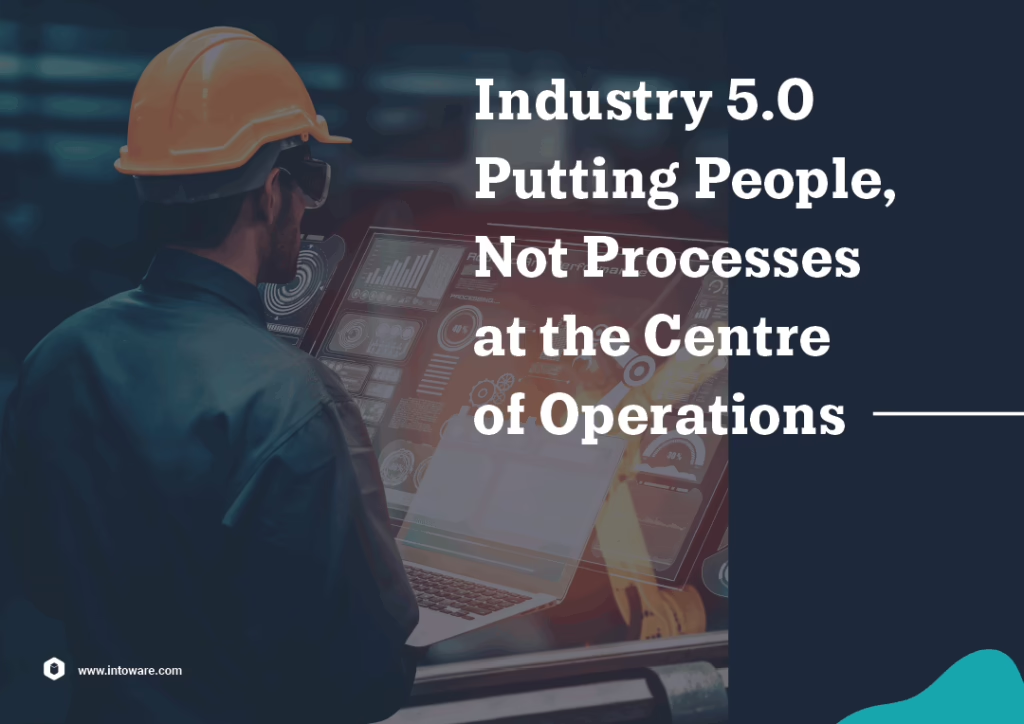
Explore the benefits of putting people, not processes at the centre of operations
From System Data to Job Execution Insight
One of the biggest differences between Industry 4.0 and Industry 5.0 lies in the type of data organisations value.
Industry 4.0 prioritised system and machine data.
Industry 5.0 recognises the importance of job execution data. The detail of how tasks are actually completed by people.
This includes:
- the steps taken
- the checks performed
- the evidence captured
- the decisions made under real conditions
When organisations can see this level of detail, they gain a far clearer understanding of how operations truly function.
Digital Execution: How WorkfloPlus Closes the Gap
WorkfloPlus turns tasks into simple digital work instructions — followed on mobiles, tablets, desktops or smart glasses — while automatically capturing evidence.
As work is completed, the system automatically records:
- the steps followed
- photos and video
- timing and duration
- signatures
- location
- measurements
- compliance checks
- exceptions or issues
Suddenly, the job execution data becomes visible.
Not weeks later. Right now.
It removes admin for frontline teams.
There’s no more guesswork for managers.
It provides evidence for auditors.
Discover why the Execution Layer is the missing link in Industry 4.0.
Download: Beyond ERP, MRP & MES: Closing the Gap Between Planning and Reality to Enable AI-Ready Operations

Why Industry 5.0 Matters Now
Several forces are driving the push towards Industry 5.0.
Workforces are changing.
Skills shortages are increasing.
Regulatory pressure is rising.
Operations are becoming more distributed and complex.
At the same time, organisations are investing heavily in AI and analytics, but discovering that those tools are only as good as the data beneath them.
Industry 5.0 addresses this by ensuring that data reflects reality, not assumptions.
It brings visibility to the human layer of operations and makes improvement possible without sacrificing safety, quality or confidence.
Industry 5.0 in Practice
In real operational environments, Industry 5.0 looks like this:
- Frontline teams receive clear guidance while they work.
- Evidence is captured automatically as tasks are completed.
- Managers gain real-time insight into execution, not just outcomes.
- Training becomes faster and more consistent.
- Compliance becomes easier to prove.
Technology fades into the background, while people remain firmly at the centre.
Human-Centred Does Not Mean Less Digital
Industry 5.0 does not means stepping back from digitalisation.
In fact, it needs a stronger digital foundations.
Systems still matter.
Automation still matters.
Data still matters.
What changes is how those tools are applied.
Industry 5.0 uses digital technology to support human work by guiding it, capturing it and learning from it. Rather than assuming it can be fully automated away.
Building Toward Industry 5.0
For most companies, Industry 5.0 is not a sudden shift.
It’s a progression.
It starts by connecting frontline work to the wider digital landscape.
By making job execution visible.
By capturing knowledge before it’s lost.
And by ensuring people are equipped to succeed in increasingly complex environments.
This is where modern digital operations platforms play a crucial role.
Examples Industry 5.0 in Action
Manufacturing
Operators follow digital steps for quality checks, ensuring processes are identical across shifts and sites.Aviation MRO
Pre-flight checks and repairs become fully traceable with recorded evidence for every action.
Utilities
Field engineers capture GPS-stamped evidence instantly, eliminating reporting delays.
Rail
Safety checks, maintenance and inspections produce perfect audit trails automatically.
Construction
Digital guidance ensures assessments are completed to standard with instant evidence.
Discover how human-centred digital operations prepare organisations for the future of work.
Explore how visibility, guidance and execution insight support resilient, people-focused operations.