
Training & Upskilling the Frontline
Building Capability Where Work Actually Happens
Training has never been more important, or more difficult.
Experienced workers are retiring, skills shortages are growing, and operations are under pressure to do more with fewer people. At the same time, work is becoming more complex, more regulated and less forgiving of mistakes.
Most companies respond by adding more courses, more documentation or more systems.
But real capability is built somewhere else.
It’s built at the point of work.

Why Traditional Training Falls Short
Classroom sessions and online courses play an important role.
But on their own, they rarely prepare people for the reality of day-to-day operations.
By the time frontline workers return to the job, much of what they learned has faded. Processes vary between sites. More experienced colleagues fill in the gaps. The work gets done, but not always consistently.
This creates risk.
Knowledge becomes tribal.
Confidence depends on experience rather than clarity.
And training outcomes are difficult to measure.
Upskilling the frontline requires more than instruction.
It requires support during job execution.
Learning Happens While Work Is Being Done
The most effective training doesn’t interrupt work. It supports it.
When guidance is available as tasks are carried out, learning becomes practical, immediate and relevant. New starters gain confidence faster. Experienced workers reinforce best practice. Variations are reduced without slowing teams down.
Over time, this approach turns everyday tasks into repeatable learning moments.
Training stops being a one-off event and becomes part of normal operations.
From Experience to Shared Knowledge
One of the biggest challenges organisations face is preserving expertise.
Highly skilled engineers and technicians often carry years of knowledge that isn’t written down. When they leave, that insight leaves with them.
Upskilling the frontline means capturing this knowledge as work is performed, and not trying to recreate it later.
When processes are guided digitally and evidence is captured as tasks are completed, you create a living record of how work is really done. This makes expertise visible, transferable and scalable.
Consistency Without Removing Autonomy
Effective training doesn’t mean rigid standardisation.
It means providing a clear baseline that people can rely on.
Frontline workers still apply judgement.
They still adapt to conditions.
But they do so within a framework that ensures critical steps are followed and important checks are completed.
This balance improves safety, quality and confidence, without removing flexibility where it’s needed.
Training That Supports Compliance and Safety
In many environments, training and compliance are inseparable.
People must not only know what to do, but be able to demonstrate that it was done correctly. Evidence matters – especially in highly regulated industries.
When training is embedded into real work, evidence of competence and compliance is captured naturally. Sign-offs, photos and confirmations become part of task completion rather than additional admin.
This reduces simplifies audits and provides reassurance that standards are being met consistently.
Learning Safely in High-Risk Environments
In safety-critical industries, training isn’t just about efficiency. It’s about reducing risk.
In the Capturing the Knowledge to Drive Rail’s Digital Transformation episode of our Digital Transformation Bytes podcast, Mark Allen of A5 Rail, discusses how digital training allows teams to practise tasks, learn from mistakes and build confidence in environments where errors aren’t acceptable in the real world.
By capturing knowledge digitally and guiding work step by step, you reduce reliance on memory and experience alone. So, people learn in context, without putting assets, safety or compliance at risk.
Trainng embedded into real work is one of the most effective ways to improve safety, consistency and long-term capability.
Upskilling in Distributed and Field-Based Teams
Training becomes even harder when teams are spread across sites, regions or countries.
Field technicians, service engineers and remote teams often work independently, with limited access to in-person support. Ensuring consistent training in these environments is a persistent challenge.
Digital guidance helps bridge this gap. It ensures that wherever work is carried out, people have access to the same standards, instructions and support. Without relying on memory or local variations.
Reducing Time to Competence
One of the clearest measures of effective training is how quickly people become confident and capable in their role.
When learning is integrated into daily work, new starters spend less time shadowing and more time contributing. They make fewer mistakes, ask fewer questions and require less intervention.
This shortens onboarding, reduces reliance on experienced staff and helps teams scale more effectively.
Free Download:
Tomorrow’s Team eBook
A guide on how digital training and upskilling helps to future-proof operations.

Training Data That Drives Improvement
Upskilling isn’t just about delivery. It’s about insight.
When training and execution layer data are connected, organisations can see where people struggle, where processes are unclear and where additional support is needed.
This turns training from a standard course into a continuous improvement loop that evolves as operations change.
Preparing the Workforce for the Future
As operations become more digital and data-driven, the role of the frontline workforce continues to evolve.
Upskilling isn’t about replacing people with technology.
It’s about equipping them to succeed alongside it.
Organisations that invest in practical, execution-led training build workforces that are adaptable, confident and ready for what comes next.
Find Out More:
Explore how connected working benefits the frontline workers, while also future-proofing business operations.
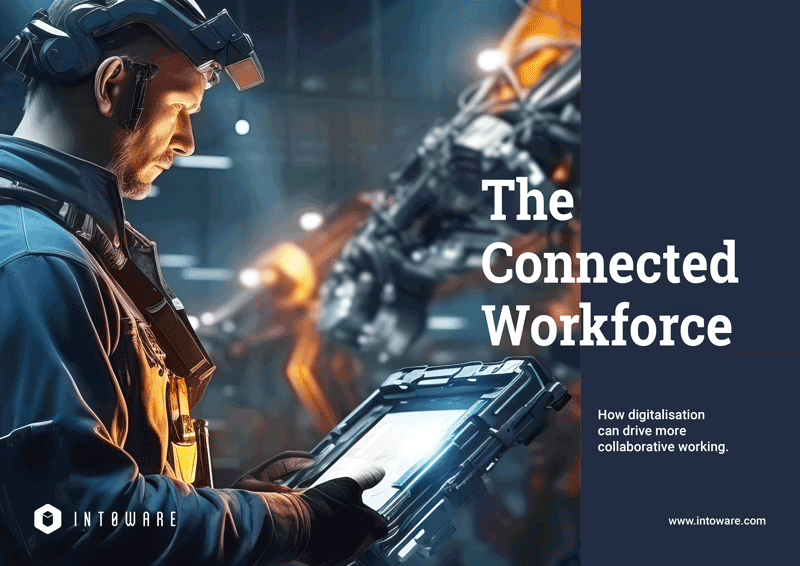
See how training becomes part of everyday work.
Explore how supporting people at the point of work accelerates learning, consistency and confidence.