
Data-Driven Continuous Improvement
Turning Everyday Work into Lasting Improvement
Like most companies, you probably already have improvement initiatives in place.
But improving continuously is difficult when you don’t have a clear view of how work is actually being carried out.
Plans tell you what should happen.
Reports tell you what happened after the fact.
What’s often missing is visibility into the work as it happens, Where small inefficiencies appear, where variation creeps in and where improvement opportunities quietly build up.
Data-driven continuous improvement closes that gap by learning directly from the job execution layer.
Why Continuous Improvement Often Loses Momentum
Continuous improvement usually starts with good intent.
New processes are introduced. Targets are set. Reviews are scheduled.
But without reliable, real-time insight into day-to-day work, improvement efforts quickly slow down.
You may find that:
- issues are identified too late
- variation becomes accepted as normal
- improvement depends on who raises concerns rather than what the data shows
The challenge isn’t commitment.
It’s visibility.
Continuous Improvement Starts Where Work Happens
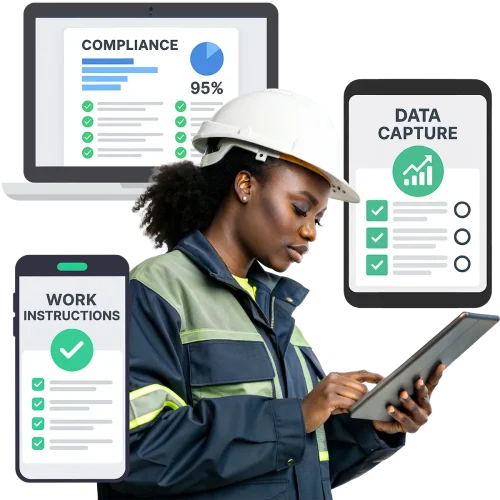
The most useful continuous improvement data is created while work is being done.
Every inspection, check and task contains insight, if that data is captured at the right moment. When information is recorded during job execution, it reflects reality rather than memory or interpretation.
This allows you to see how work is really carried out, where processes vary and which steps cause friction.
Improvement becomes evidence-led, not assumption-led.
From Looking Back to Acting Earlier
Traditional improvement relies heavily on hindsight.
KPIs and reports explain what happened, but rarely why.
When execution data is available as work is completed, patterns become visible sooner. You can spot issues earlier, support teams in the moment and prevent small problems from turning into larger ones.
This makes improvement faster, more focused and far less disruptive.
Learning While Doing the Work
It’s easy to focus improvement efforts on incidents, failures or audits.
But the biggest opportunity often lies in understanding how normal work is carried out.
By learning from tasks that are completed successfully every day, you can identify best practice, reduce unnecessary variation and create digital standard operating procedures.
Continuous improvement becomes about learning and refinement, rather than firefighting.
Making Improvement a Shared Effort
Sustainable improvement doesn’t sit with one team.
It works best when the people doing the work are part of the process.
When you can see how tasks are completed in practice, conversations change. Feedback becomes specific. Improvements are grounded in evidence. Everyone feels supported rather than scrutinised.
You move from debating opinions to discussing facts.
Improving Safely in Regulated Environments
If you operate in a regulated or safety-critical environment, improvement must never compromise compliance.
Execution data helps you understand which steps are essential, which checks and inspections protect safety and where change is appropriate. You can improve processes with confidence, knowing that standards and traceability are maintained.
This makes improvement safer as well as smarter.
Building the Foundation for What Comes Next
Continuous improvement and AI readiness are closely linked.
When you capture consistent, real-world execution data, you create the foundation for deeper insight, advanced analytics and future AI use. Without having to change direction later.
Improvement today becomes preparation for tomorrow.
Whitepaper Download:
How to Unlock the Value in Data

Making Improvement Stick
The hardest part of improvement isn’t starting.
It’s sustaining it.
When improvement relies on workshops or meetings, it competes with daily work. When it’s built into job execution, it becomes part of how you operate.
Small changes accumulate.
Visibility improves.
Confidence grows.
Improvement becomes habitual, not hard work.
Download the Beyond ERP, MRP & MES eBook:
Explore how you can close the gap between planning and execution, and enable continuous improvement.